Have you ever been interested in learning the art of metalsmithing in order to create your own, one-of-a-kind jewelry? In this Beginning Metalsmithing and Jewelry course, students will learn to solder, texture, saw, file, and set a stone while creating a beautiful ring to take home. Students will also learn jewelry studio safety protocols and how to properly use and care for the tools. No previous metalsmithing experience is required. Upon completion of this course, students may sign up to use the studio during open studio hours.
Read more ...

Art Under Glass
Supply List
 
We’ll work from life for this workshop. Glass models will be provided. You are welcome to also bring any glass object that intrigues (or scares) you.
 
Please bring
--Soft pastels--as many colors as you have
--Nupastels—also as many colors as you have  
--Sanded paper  —I’ll have Art Spectrum ColourFix (in Aubergine and Burnt Umber colors) available for purchase, at my cost (about $10). Or you can bring your own ColourFix or other sanded paper, medium to dark colors.
Cut this to 9x12, 8x10, 11x14” sizes (you can do this at the workshop)
--Hard backing to put behind sanded paper on the easel (I use a 14x16” piece of gator board or foam core)
--Easel (Prairie Arts has some standing and table easels; or you can bring your own.)
--Masking tape (please, not blue)
--Aluminum foil
A piece 18-24" long, to put on easel tray to catch pastel dust
--Viva paper towels
Viva brand is the best, for its softness
--Sketchbook
For notes and any thumbnail sketches
--Drawing pencil (2B would be good)
--Brushes
     An old filbert or flat brush, 1/2” or so, for softening edges or removing pastel 
     An old 1 - 2” household (or flat) paint brush, for underpainting
--Cell phone, tablet, or camera
 
Optionals
A portable light for your easel. Can be a clip-on or floor light. Preferably with daylight/color-correct bulb
 
Sources
Pastels and sanded papers
Soft pastels, Nupastels, and sanded papers are not available in Stillwater. 
 
In OKC, Porch School and Art Supply (near 50th & Santa Fe) carries some hard and soft pastels and sanded papers. (A great art supply place, by the way.)
In Tulsa, Ziegler’s carries some hard and soft pastels and sanded papers.
 
Or you can order pastels and sanded papers online: Terry Ludwig (www.terryludwig.com), Dakota Pastels, 
Dick Blick, Jerry’s Artarama, Cheap Joe’s.
 
Yes, soft pastels are expensive, but they last a very long time. And they're wonderful! 
If you can, get at least a few colors to try. 
 
1. Soft pastel brands:
Terry Ludwig                 Sennelier
Unison                           Great American
Schmincke                    Diane Townsend
Mount Vision                Girault
Henri Roche                  Holbein
Richeson Handrolled

Rembrandts are harder than most soft pastel brands, but will work.
 
I use mainly Terry Ludwigs and a smattering of the other brands. 
 
2. Hard pastel brands:
Nupastels 
Gallery (not preferred but will do) 
 
3. Sanded papers:
I use mainly Art Spectrum's ColourFix paper, dark colors. I buy the large 19x27" sheets and cut them into smaller sizes. 
I'll have ColourFix large sheets on hand for the workshop, in Aubergine (cool violet gray) and Burnt Umber (warm dark brown). You can buy these at my cost. (Should be about $10 each.) You’ll need 1-2 large sheets. We’ll cut them to 9/12”, 8x10” 11x14” sizes at the workshop
You are welcome to bring your own paper, if you prefer; just please be sure it is sanded paper.
 
Other brands of sanded paper:
Some of these are light in color. Light-colored paper is not my preference, but you may like it. Or underpaint on it first, to tone it.  
        UArt (400 or 500 grit recommended)
Lux Archival
LaCarte
PastelMat
Pastel Premier
Richeson
Ampersand Pastelbord

Fresh Flowers
Supply List
We’ll work from life with fresh flowers for this workshop. Flowers will be provided (supply fee under $10). You’re welcome to bring any others you’re interested in painting. 
Please bring
--Soft pastels--as many colors as you have
—Nupastels or other hard pastels—also as many colors as you have  
--Sanded paper  —I’ll have large sheets of Art Spectrum ColourFix (in Aubergine and Burnt Umber colors) available for purchase, at my cost (about $10 each). You are welcome to bring your own paper, if you prefer; just please be sure it is sanded paper. Preferably medium to dark colors
Cut this to 9x12, 8x10, 11x14" sizes (you can do this at the workshop)
--Hard backing to put behind sanded paper on the easel (I use a 14x16” piece of gator board or foam core)
--Easel (Prairie Arts has a few standing and table easels; or you can bring your own)
--Masking tape (please, not blue)
--Aluminum foil
A piece 18-24" long, to put on easel tray to catch pastel dust
--Viva paper towels
Viva brand is the best, for its softness
--Sketchbook
For notes and any thumbnail sketches
--Drawing pencil (2B would be good)
--Brushes
     An old filbert or flat brush, 1/2" or so, for softening edges or removing pastel 
     An old 1" or 2" household (or flat) paint brush, for underpainting
--Cell phone, tablet, or camera
Optionals
A portable light for your easel. Can be a clip-on or floor light. Preferably with daylight/color-correct bulb
Sources
Pastels and sanded papers
Soft pastels, Nupastels, and sanded papers are not available in Stillwater. 
In OKC, Jerry’s Artarama carries some hard and soft pastels and sanded papers.
In Tulsa, Ziegler’s carries some hard and soft pastels and sanded papers.
Or you can order pastels and sanded papers online: Terry Ludwig (www.terryludwig.com), Dakota Pastels, Dick Blick, Jerry’s Artarama, Cheap Joe’s.
Yes, soft pastels are expensive, but they last a very long time. And they're wonderful! 
If you can, get at least a few colors to try. 
1. Soft pastel brands:
Terry Ludwig Sennelier Mount Vision Girault
Unison Great American Henri Roche    Holbein
Schmincke Diane Townsend Diane Townsend Richeson hand-rolled
 
Rembrandts are harder than most soft pastel brands, but will work.
I use mainly Terry Ludwigs and a smattering of the other brands. 
2. Hard pastel brands:
Nupastels 
Cretacolor
Gallery (not preferred but will do) 
3. Sanded papers:
I use mainly Art Spectrum's ColourFix paper, dark colors. I buy the large 19x27" sheets and cut them into smaller sizes. 
I'll have ColourFix large sheets 

Supply List
We’ll work from photos––mine and yours. 
Please bring
--Soft pastels--as many colors as you have
—Nupastels or other hard pastels—also as many colors as you have. I highly recommend the full set of Nupastels (96 sticks).  
--Sanded paper  —I’ll have large sheets of Art Spectrum ColourFix (Aubergine color) and UArt 400 grit (Cream color) available for purchase, at my cost (about $10 each). You are welcome to bring your own paper, if you prefer; just please be sure it is sanded paper. Preferably medium to dark colors
Cut this to 9x12, 8x10, 11x14" sizes (you can do this at the workshop)
--Hard backing to put behind sanded paper on the easel (I use a 14x16” piece of gator board or foam core)
--Easel (Prairie Arts has a few standing and table easels; or you can bring your own)
--Masking tape (please, not blue)
--Aluminum foil
A piece 18-24" long, to put on easel tray to catch pastel dust
--Viva paper towels
Viva brand is the best, for its softness
--Sketchbook
For notes and any thumbnail sketches
--Drawing pencil (2B would be good)
--Brushes
     An old filbert or flat brush, 1/2" or so, for softening edges or removing pastel 
     An old 1" or 2" household (or flat) paint brush, for underpainting
--Cell phone, tablet, or camera
Optionals
A portable light for your easel. Can be a clip-on or floor light. Preferably with daylight/color-correct bulb
Sources
Pastels and sanded papers
Soft pastels, Nupastels, and sanded papers are not available in Stillwater. 
In OKC, Jerry’s Artarama carries some hard and soft pastels and sanded papers.
In Tulsa, Ziegler’s carries some hard and soft pastels and sanded papers.
Or you can order pastels and sanded papers online: Terry Ludwig (https://terryludwig.com/), Dakota Pastels, Dick Blick, Jerry’s Artarama.
Yes, soft pastels are expensive, but they last a very long time. And they're wonderful! 
If you can, get at least a few colors to try. 
1. Soft pastel brands:
Terry Ludwig Sennelier Mount Vision Girault
Unison Great American Henri Roche    Holbein
Schmincke Diane Townsend Diane Townsend Richeson hand-rolled
 
Rembrandts are harder than most soft pastel brands, but will work.
I use mainly Terry Ludwigs and a smattering of the other brands. 
2. Hard pastel brands:
Nupastels 
Cretacolor
Gallery (not preferred but will do) 
3. Sanded papers:
I use mainly Art Spectrum's ColourFix paper, dark colors. I buy the large 19x27" sheets and cut them into smaller sizes. 
I'll have ColourFix large sheets on hand (Aubergine color) and UArt 400 grit (Cream color). You can buy these at my cost (about $10 each.) You’ll need 1-2 large sheets. We’ll cut them to 9/12”, 8x10” 11x14” sizes at the workshop
You are welcome to bring your own paper, if you prefer; just please be sure it is sanded paper.
 
Other brands of sanded paper:
Some of these are light in color. Light-colored paper is not my preference, but you may like it. Or underpaint on it first, to tone it.  
        
UArt (400 or 500 grit recommended) Pastel Premier
Lux Archival Richeson
LaCarte Ampersand Pastelbord
PastelMat
Thanks, Jude
Jude Tolar, PSA, IAPS/MC*
http://www.judetolar.com/ Click to follow link." data-outlook-id="6b280b3c-cf33-4f63-9a15-e170c84eb324" style="color: rgb(224, 129, 68);">www.judetolar.com
*Signature Member, Pastel Society of America
*Master Circle Pastelist, International Association of Pastel Societies

We are happy to welcome you into the Prairie Arts Pottery Studio community. This space is shared by many students and artists with a wide range of experience levels. Our goal is to provide an environment that is creative, respectful, and well cared for.

Because tools, equipment, and materials are shared, it is important that everyone understands and follows the studio guidelines. These expectations help keep the studio safe, functional, and enjoyable for all. Please read through this information carefully before working in the studio.

Ceramic Studio Upkeep

  • Leave your workspace as clean as—or cleaner than—you found it.

  • Wash clay from your hands in the classroom sinks only. Restroom sinks may not be used for clay.

  • Cover and store your work on your assigned shelf:

    • Wheel 1 students: half of one shelf (in designated area)

    • Wheel 2 students: one full shelf (in designated area)

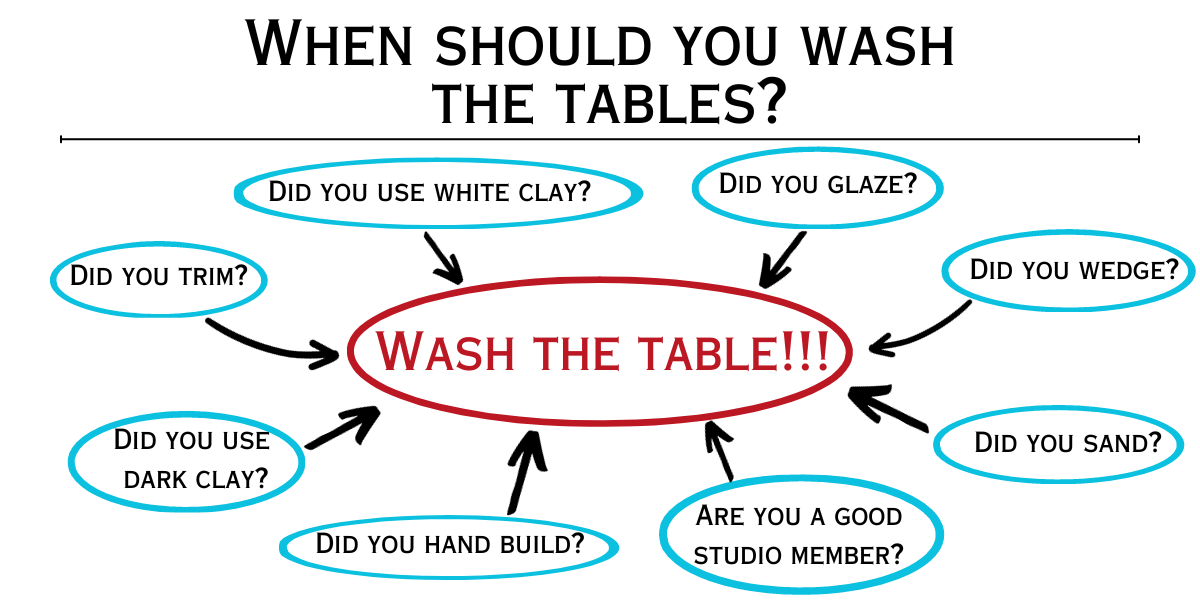
Wash the tables Canva Banner

Reclaim and Sink Use

Proper clay disposal is essential to protecting studio plumbing. Please follow the three-stop system below:

STOP 1: Soft Clay

    • Trimmings and soft clay scraps go in the bucket under the extruder.

STOP 2: Slop

    • The large sink next to the double sink is the slop sink.

    • Clay slurry, slop buckets, clay from tools or hands, and hard unfired clay should go here.

STOP 3: Rinse

    • The double sink is for rinsing only.

    • Wash tools, hands, buckets, and bats here after removing excess clay at the slop sink.

    • Only minimal clay residue should go down this drain.

Wheel and Tool Care

  • Clean all parts of the wheel after use.

  • Place the stool on top of the wheel head when finished.

  • Keep foot pedals on the wheel base and not hanging.

  • Return all shared tools to their designated storage areas.

  • If you borrow tools from an instructor, return them clean and promptly.

Studio Etiquette

  • Always wash your table if you worked with clay, glaze, or sanding materials. When in doubt, wash the table.

  • Follow all glazing instructions carefully.

  • Use designated wedging and glazing tables to prevent contamination.

  • The wedging table is centrally located and includes a scale and scrapers.

  • Be mindful of the space that you take up and what others might need, espcially during open studio hours.

  • Personal music must be listened to through headphones.

  • Instructors determine when music is played for the entire studio and may choose to have no music if it becomes distracting.

  • Your name must be carved into every piece you make or may not be fired.

  • You'll need to sign in and out at the front desk whenever you visit the studio, even if you're only there for a moment to pick up an item. Additionally, we may request to see what you’re bringing into the studio to ensure the safety of the studio.

Clay and Materials

  • Outside clay is not allowed.

  • Clay, bisque, or glazed work made elsewhere may not be fired in Prairie Arts Center kilns.

  • Clay may not be taken home and returned for firing.

  • All clay must be clearly labeled with your name and date.

  • Clay left unused for more than 30 days will be reclaimed.

  • Personal glazes must be approved by an instructor or front desk staff before use.

Ceramic Studio Safety

  • Students are not allowed in the kiln room or clay room.

  • Do not open, load, or unload kilns. Only instructors or Prairie Arts Center staff may do so.

  • With the exception of Monday evenings, all participants must enter through the main entrance. For open studio, participants are required to sign in and sign out.

  • Jewelry is best left at home, as rings and watches can interfere with clay work.

  • Prairie Arts Center is not responsible for lost or damaged personal items.

  • Items should not be placed on top of shelves unless the shelf is against a wall.

  • When an instructor-led class is in session during open studio hours, please allow the class to proceed without interruption.

  • Open Studio participants should bring their own tools.

  • If you borrow studio tools during open studio, please ask first and return them clean. If you used an instructor’s tools during class, you still need to ask before using them.

30-Day Firing Policy

  • Finished pieces must be picked up within 30 days of the final firing date.

  • Work not collected within 30 days will be considered abandoned and becomes property of the Prairie Arts Center.

  • Abandoned work may be discarded, sold, or used to support the scholarship fund.

  • Finished work may only be picked up during studio hours when a ceramics instructor is present.

  • Ceramics are not guaranteed, and things can happen during loading and firing. We do our best to make sure each piece turns out well, but there are many factors that can affect the outcome in a community kiln.

Open Studio Access

  • After completing your introductory class, you may attend Open Studio to finish work already in progress.

  • New projects may only be started by current Open Studio participants.

  • If it has been more than three months since you completed an introductory course, you may be required to repeat the course.

  • Shelves must be cleared no later than one week after your class ends. Any work left after that time becomes property of the Prairie Arts Center.

  • If you discontinue Open Studio, your shelf and locker must be cleared by the 5th of the month to avoid being charged for the following month.

Lockers

  • Lockers are available to Open Studio participants on a first-come, first-served basis for $10 per month.

  • If you discontinue Open Studio, your shelf and locker must be cleared by the 5th of the month to avoid being charged for the following month.

Accessibility

The Prairie Arts Center is wheelchair accessible.
If you need accommodations, please notify your instructor or the PAC Director so arrangements can be made.

All Participants Must Sign Yearly.

Date:________________

By participating in the pottery studio, you agree to the guidelines outlined above. PAC members

who fail to abide by these rules may be asked to not attend.

I _______________________________________(print name) agree to abide by the Prairie

Arts guidelines for working in the pottery studio. I understand that if I fail to follow these rules,

my privileges may be revoked. _______________________________________ (Signature)

Register Here Button Samples


This is an example of a button included within a line of text.  This button was inserted normally. The Advanced tab of the image properties must include "display: inline-block;" in the Style field. If not, the button won't flow with the text, but will instead break onto its own separate line.


This is an example of a button included within a line of text.  In image properties for this button, the alignment drop-down was set to "bottom" to allow the button to sit on the baseline with the text, instead of in the middle as above. The Advanced tab of the image properties must include "display: inline-block;" in the Style field. With the alignment also set, the Style field will look like this: "vertical-align: bottom; display: inline-block;"

Tabs Example

Sliders Example